Blog/Vision
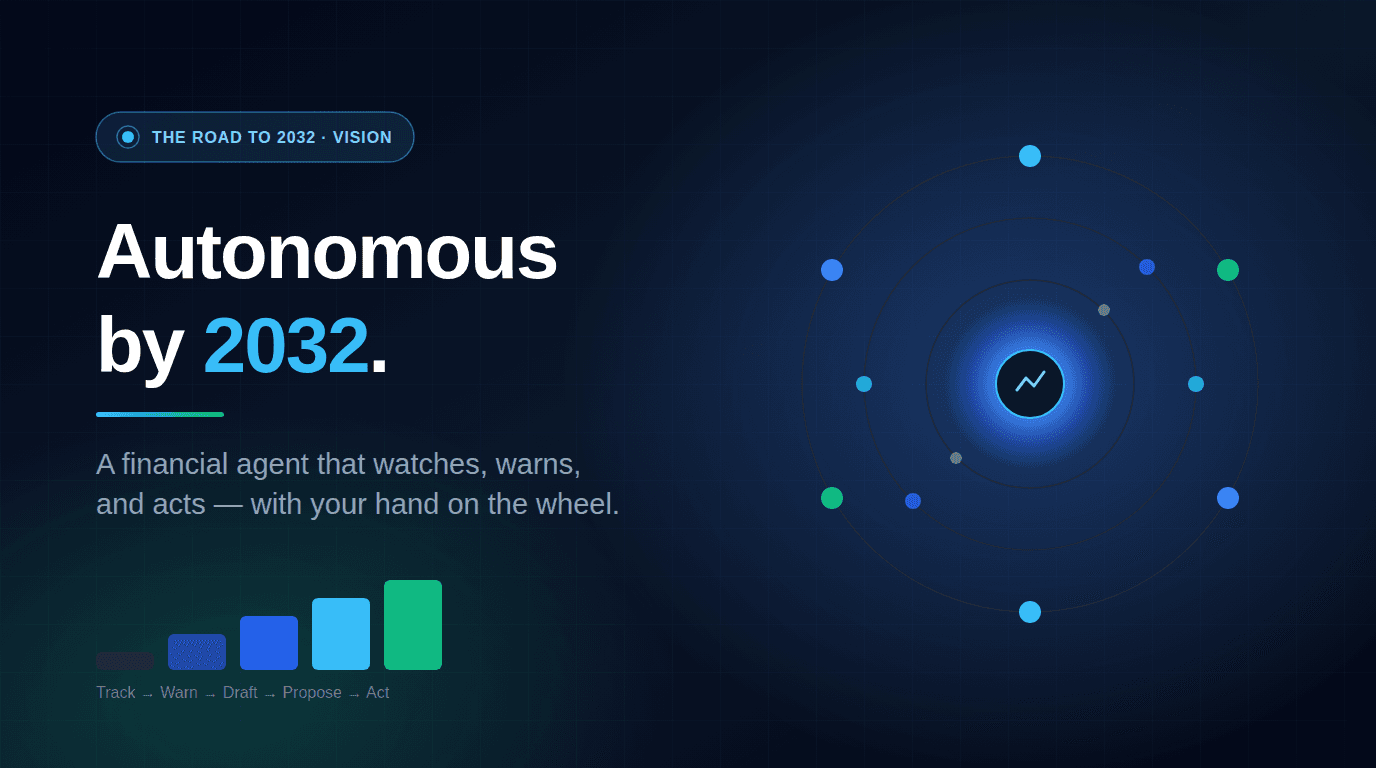
QuantRidge 2032: The Road to a Fully Autonomous Financial Agent
·~12 min read
By 2032 we intend QuantRidge to run your financial life end to end — an agent that pays continuous attention, prepares the work before you ask, acts within limits you set, and hands back the one thing money has always cost you: your attention. This is the roadmap, the autonomy ladder we plan to climb, and the commitments we will not trade away to get there.
A morning in 2032
It is a Tuesday. You have not opened a spreadsheet in four years. You do not know your account balances to the dollar, and you have stopped needing to, in the same way you stopped needing to know your engine's oil pressure.
What you have instead is something that has been paying attention on your behalf — continuously, quietly, for years — and that surfaces the handful of things each week that genuinely deserve a human being's judgment.
- 06:40Morning brief
Markets opened lower in Asia; your portfolio is down 1.1% overnight, entirely from one holding. Nothing here needs a decision. Two things worth knowing before your 9am.
- 09:15Cash flow
Your cash buffer now covers 4.1 months of fixed costs. Three months ago it covered 6.2. Spending is not the cause — the tuition transfer is. Two ways to rebuild it by March.
- 11:02Estate event
I have organized what you sent about your mother. Four accounts identified, two with outdated beneficiaries. Draft paperwork is ready. Nothing has been filed and nothing will be without you.
- 16:30People
Maya graduates on Friday. A note is drafted in your voice, ready to send when you approve it. You asked me never to send these on my own — I have not.
Notice what is happening in that feed. Three of those four items are not investment decisions at all. One is a slow-moving cash flow problem caught while it is still small. One is the administrative wreckage that follows a death in the family, quietly organized before anyone had the energy to face it. One is a graduation that would otherwise have been remembered on Saturday.
That is the thesis in a sentence: the hard part of financial life was never the investing. It is the attention. Nobody has enough of it, the consequences of running out arrive years later, and until very recently the only fix was to pay a person a percentage of everything you own to pay attention for you.
This is where we intend to take QuantRidge by 2032, and how we plan to get there.
Why this becomes buildable now
People have promised automated financial life management before, and it did not arrive. The reason is worth being precise about, because it explains why the next decade is different from the last one.
The reasoning gap closed. Until recently, software could execute rules but could not weigh a messy, underspecified human situation. Rules-based automation handles "rebalance when equities exceed 65%". It cannot handle "your mother died, here are eleven documents, what do I need to do?" Systems that can reason across unstructured context are new, and they are the missing piece.
Financial data became reachable. Account aggregation, standardized statements, and machine-readable filings mean the complete picture can now be assembled from the outside. A decade ago the data lived in eleven institutions that had no interest in sharing it.
The economics inverted. Continuous attention used to require a salaried human, which is why it was priced as a percentage of assets and reserved for people with millions. When the marginal cost of attention collapses, the natural price stops being a percentage of your wealth and becomes a flat subscription — which is the argument we already make today, simply extended forward.
Those three curves cross before the end of this decade. We are building for the far side of that crossing.
The autonomy ladder: L0 to L5
"Fully autonomous" is a phrase that hides more than it reveals, so we borrow the framing self-driving uses. Autonomy is not a switch. It is a ladder, and every rung has to be genuinely earned before the next one is safe to attempt.
- L0Manual
Spreadsheets and a brokerage app. You gather the data, you do the analysis, you remember the deadlines.
Where most people still are - L1Tracking
One complete record. Accounts, lots, beneficiaries, and documents live in a single place that stays current.
Shipping today - L2Watching
The system monitors continuously and tells you when something has changed enough to matter — drift, a harvest window, a stale beneficiary.
Shipping today - L3Drafting
It does not just flag the problem, it prepares the answer: the rebalance, the conversion schedule, the paperwork, the message — all waiting for your review.
In progress - L4Proposing
It runs your financial life end to end and comes to you with decisions, not data. You approve, adjust, or decline. The work is already done.
Toward 2030 - L5Acting
Within limits you set, it executes: routine rebalancing, harvesting, transfers, filings, reminders to the people you love. It reports what it did and why.
The 2032 goal
The important thing about this ladder is that trust is the rate limiter, not capability. We will be technically able to act on your behalf well before most people are comfortable letting us. That is the correct order. A system that moves money has to earn the right to do so over years of being visibly, checkably right about smaller things first.
The roadmap: four phases to 2032
2026: the record
Everything begins with one complete, current picture: accounts, tax lots, beneficiaries, property, equity compensation, insurance, and documents. This is unglamorous and it is the whole foundation — an agent cannot reason about a life it cannot see. This is what the 155 capabilities shipping today are building.
2027 – 2028: the guardian
The system stops waiting to be opened. It watches continuously and speaks up when something crosses a threshold that matters: concentration creeping up, a harvest window closing, a beneficiary that no longer matches your intent, a cash buffer thinning three months before you would have noticed. Most of the value in this phase is measured in mistakes that never happen.
2029 – 2030: the drafter
The agent stops handing you problems and starts handing you finished work. The rebalance is modeled with its tax consequence attached. The Roth conversion schedule is built across four years. The estate paperwork is filled in. The message to your daughter is written in something that sounds like you. Everything waits for your approval; nothing waits for your effort.
2031 – 2032: the agent
Within limits you set explicitly — dollar thresholds, categories, counterparties, and a standing veto — it acts. Routine rebalancing happens. Harvests happen inside the window. Filings go out on time. Birthdays are not missed. Every action is logged, reversible where reversibility is possible, and reported back in plain language.
What the agent will actually do
Concretely, across the domains that make up a financial life:
Watch the money continuously
Cash flow, savings rate, concentration, drift, fees, and risk — monitored every day rather than reviewed every quarter. When your cash flow needs fixing, you hear about it in the month it starts, not the year it becomes a problem, and you hear a proposal rather than an alarm.
Brief you every morning
A daily read on markets and, more usefully, on your exposure to them: what moved, what it means for what you own, what risk has quietly grown, and — most days — an explicit statement that nothing requires you to do anything. A system trusted to say "no action needed" is worth more than one that manufactures urgency.
Handle the events that flatten people
A death in the family, an inheritance, a divorce, a diagnosis, a layoff, a liquidity event. These arrive with administrative burden at precisely the moment nobody has capacity for it. The agent identifies the accounts, surfaces what must happen and by when, prepares what can be prepared, and routes the rest to the right professional. It cannot make grief lighter. It can stop grief from also costing you money.
Coordinate the professionals
Your CPA, your attorney, your advisor if you keep one. The agent assembles what each of them needs in the format they want it, ahead of the deadline. Less of what you pay them for goes into reconstructing your situation from scratch.
Remember the people
Graduations, weddings, anniversaries, the holidays. The agent keeps track and drafts something in your voice, with a photograph or a note if you want one — then waits for you to say yes. We will not send messages as you without your explicit sign-off on each one, because a relationship maintained by an unattended machine is not a relationship. The point is not to automate affection. It is to stop a busy year from quietly eroding it.
The hard part: consent, control, and the off switch
A system with this much reach is only worth building if it is genuinely trustworthy, so these are commitments rather than features:
- Autonomy is granted, never assumed. Every level of independence is something you switch on, scoped to categories and dollar limits you set, and can revoke instantly.
- You keep custody. Your assets stay at your own institutions. We have spent this entire company being a system of analysis rather than a holder of your money, and that does not change because the software gets smarter.
- Every action is explained and logged. Not a black box that reports outcomes — a record of what was done, why, what alternatives were considered, and how to undo it.
- Nothing is sent as you without your approval. Especially to the people you love.
- Your data is not the product. A flat subscription means we are paid by you, which means our incentive is to be right rather than to be interesting.
- There is always an off switch, and turning it off leaves you with a complete, exportable record rather than a hostage situation.
We would rather arrive at 2032 having moved more slowly and kept every one of these than having shipped autonomy that nobody could safely rely on.
Why this is a large opportunity
For readers thinking about this commercially rather than personally, the argument is straightforward.
The service exists and is priced for the wealthy. Comprehensive financial attention is not a new product — it is what a good private wealth relationship provides, at roughly 1% of assets a year. That price puts it out of reach of almost everyone below the top few percent, not because they need it less, but because a percentage fee on a smaller balance cannot fund a human's time.
The bottleneck is attention, and attention is exactly what is getting cheap. That is the arbitrage. A capability previously rationed by headcount becomes available at software margins, and the addressable population expands by an order of magnitude.
The moat is the record, not the model. Models will be commoditized; everyone will have access to comparable reasoning. What is not commoditized is a multi-year, complete, reconciled history of one household's financial life — every lot, every beneficiary, every document, every decision and its rationale. That record takes years to accumulate, gets more valuable the longer it runs, and is what makes the agent's judgment specific to you rather than generic. Starting to build it now is the entire point.
Alignment is structural. An AUM fee grows when your balance grows, whatever the advice was worth. A flat fee only renews if the thing keeps being useful. That is a harder business to run and a much easier one to trust — and trust is the binding constraint on everything above L3.
If you would like to talk about this in more depth, our investors page is the place to start, or reach us directly at support@quantridge.net.
What is true today
Everything above from L3 upward is where we are going. It is not what you get when you sign up this afternoon, and we would rather say so plainly than let a vision post do the work of a product page.
What exists today is L1 and L2, and it is substantial: 155 capabilities spanning portfolio analytics, tax-lot tracking with wash-sale and harvest alerts, retirement and withdrawal modeling, estate and beneficiary organisation, an encrypted document vault, AI research agents, and firm-level tools for RIAs — for $175 a month, flat, with a 14-day trial.
The record you start building today is the same record the 2032 agent will reason over. That is not a marketing line — it is the actual architecture, and it is why the most valuable thing an early user does is simply start.
Forward-looking statements. This article describes QuantRidge's product vision and intended direction. It is not a commitment to deliver any specific capability, on any timeline, and describes functionality that does not exist today. Roadmap items beyond current release are subject to change, and some may depend on regulatory, custodial, or third-party developments outside our control. Nothing here is an offer to sell or a solicitation to buy securities, and nothing here is investment, tax, or legal advice. QuantRidge is a software platform, not a Registered Investment Adviser, broker-dealer, tax preparer, or law firm. See our legal disclosures for detail.
© 2026 QuantRidge. Educational content; not tax or investment advice.